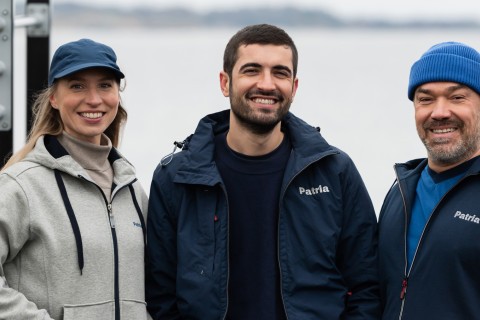


Tuure Kajava, Director, Patria Drones
Tuure Kajava develops drone solutions for demanding conditions
Tuure Kajava develops drone solutions at Patria that can operate in -30 degree weather and integrate into other defense systems. According to the industry professional, there are also misconceptions about drones.
1.5
years at Patria
Director, Patria Drones
Engineer in Information and Communication Technology
Jogging, hiking and playing games
As a young man, Tuure built model aircraft powered by electric motors, but at the time, he could not have guessed that unmanned aerial vehicles would one day become an interesting career path for him.
Tuure now works as a director at Patria’s drone solutions development and manufacturing unit in Muurame. He leads a product line composed of drone systems and acts as the immediate supervisor of the production facility.
Tuure graduated as an engineer in information and communication technology from Oulu University of Applied Sciences. His first contact with drones came from the school’s Arctic Drone Lab innovation center, from which he moved to Nordic Drones, a company manufacturing devices designed for professional use.
Tuure joined Patria through a company acquisition when Patria bought Nordic Drones in 2024.
– The combination is good. We have specialized expertise in drones and the ability to quickly develop new solutions. Patria, on the other hand, has strong experience in developing defense equipment and scalable production, Tuure says.
Patria has strong experience in developing defence equipment and scalable production.
Instead of individual drones, complete solutions
According to Tuure, modularity is essential in developing drone systems so they can be updated and adapted according to need. Another key factor is integrating individual devices as part of intelligence, surveillance, and command systems.
– Previously, many drone systems operated on a so-called point-to-point principle. The connection was from the controller to the drone, but not much further. Now the goal is different.
Tuure is involved in developing systems where drones can be used as part of other defence systems, for example, in forming a broader situational picture. Information obtained from the air can be used, for example, to direct indirect fire and for various intelligence and surveillance tasks.
– Instead of individual devices, we sell comprehensive solutions where drones are integrated into other systems. In addition, we offer user training and equipment maintenance and upkeep, which ensure performance for years to come.
Instead of individual devices, we sell comprehensive solutions where drones are integrated into other systems.
The technology must also work in arctic conditions
Tuure says that Patria’s drone development has taken into account the challenging northern conditions. In February, he presented the technology to international guests at the Griffin Tech Days event in Lapland, where the focus was on defence solutions created for arctic conditions.
– One day, it was minus 30 degrees. Military observers got to see the real environment where drones need to be able to operate. It is precisely in these conditions that you can measure whether the system is truly usable.
Russia’s invasion of Ukraine placed drones at the center of warfare. They have also become prominently discussed publicly in Finland.
– Nowadays, it seems everyone has some kind of opinion about drones, Tuure notes.
For a drone industry expert, the discussion can sometimes be frustrating, as inexpensive devices intended for hobby use and high-performance professional equipment are easily confused.
According to Tuure, a common misconception is that you could simply build an effective drone system from parts bought online. This belief can be reinforced by improvised solutions that Ukrainians have had to create out of necessity.
– In Western society, drones intended for military use are not built in garages. They require carefully designed and scalable industrial production, where things like standardization and user safety are carefully considered.
As a counterbalance to an interesting job, Tuure spends his free time with his family and working on his home. His model aircraft hobby has been replaced by jogging.
– Nowadays, I get to work with unmanned aerial vehicles enough at work, so as a hobby, they've taken a back seat for now.
Text: Matti Remes