
















Seamless operations, even in the most challenging RF environments. With Patria CANDL’s robust performance and high reliability, your missions are always in safe hands.
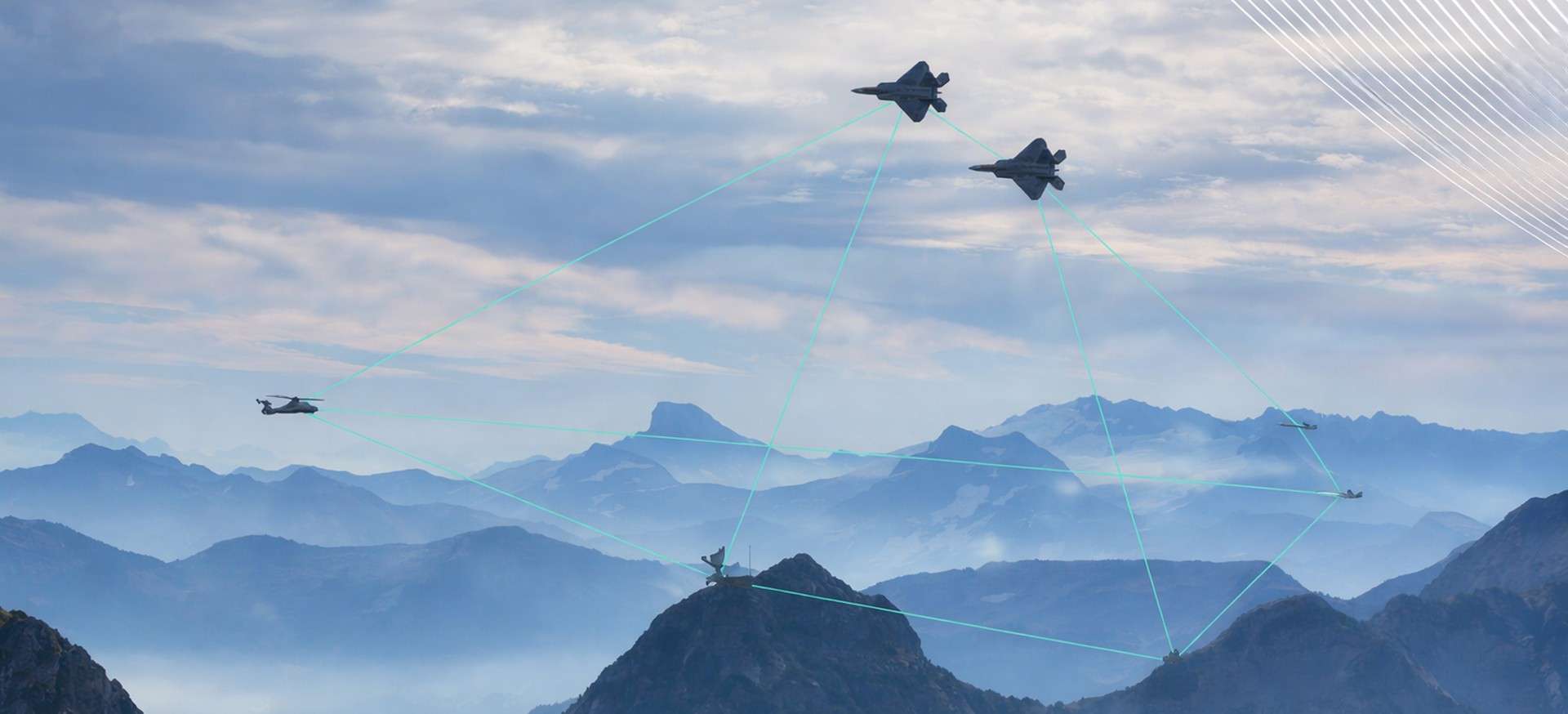
But reality is more complex extending reach introduces a new vulnerability layer: RF emissions. Networking UAVs among themselves and with manned platforms – in the air or at sea – demands the ability to remain undetected, to withstand jamming, and to operate Beyond Line of Sight (BLOS) for full domain awareness, in any environment.
Patria knows this environment well. For decades, it has been developing systems designed to operate under pressure. Since 2017, that experience has taken shape in its Compact Airborne Networking Data Link – Patria CANDL, enabling uninterrupted, secure situational awareness across domains – wherever the mission takes place.
Over the past decade, UAVs have become central to persistent, long-range ISR. Whether operating independently or as part of a Manned-Unmanned Teaming (MUM-T) configuration, they extend situational awareness without exposing personnel.
The challenge today is no longer fielding UAVs, but networking them into a single operational picture that remains usable under real operational pressure.
Patria CANDL was built to solve exactly that.
Over the past decade, UAVs have become central to persistent, long-range ISR.
Built on a compact Software Defined Radio (SDR) architecture, it connects up to 24 airborne and ground nodes in a dynamic TDMA mesh network, sharing capacity across the force and reconfiguring as the operational picture evolves. Bandwidth is allocated by priority: command and control data comes first, while payload, sensor feeds, motion video and voice communications share the remainder across multiple Quality of Service levels.
Full IP compatibility sits at the core of the system. Rather than forcing users to adapt to proprietary protocols, Patria CANDL receives standard IP traffic and converts it directly into its waveform. Integration becomes straightforward: UAVs, aircraft, ground stations and naval platforms connect much like devices on a network, allowing onboard systems and software applications to communicate using their native IP based interfaces, without custom adaptation layers.
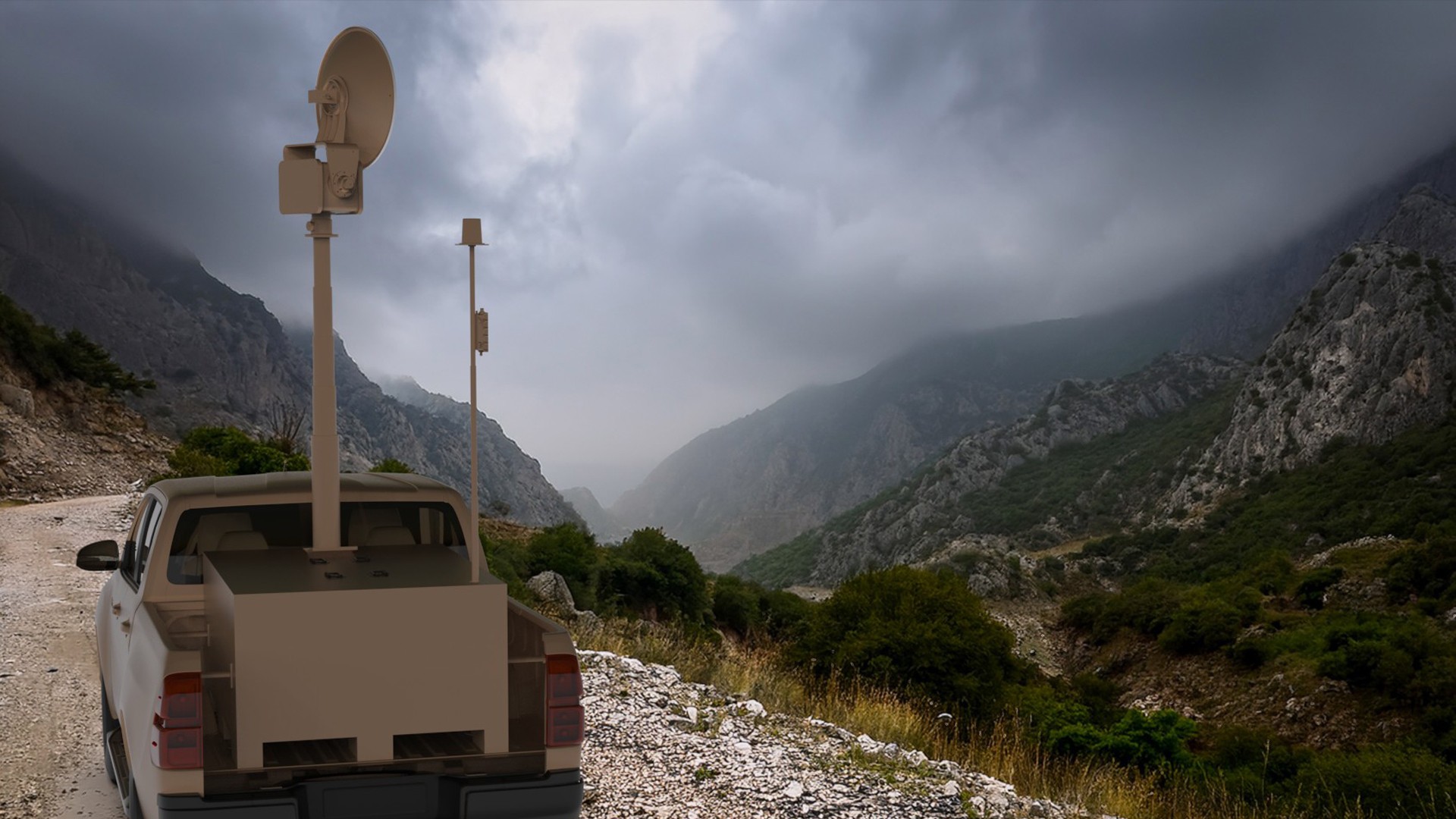
Operational range scales with network geometry rather than a single radio link. The system operates beyond 150 km line of sight, extending beyond 250 km with an external High Power Amplifier (HPA). Relay between nodes allows the network to stretch further still, connecting platforms that would otherwise remain out of reach.
Connectivity comes at a cost. Every transmission carries the risk of detection. In contested electromagnetic environments, particularly against peer adversaries with advanced SIGINT capabilities, that risk is immediate. Data links can be detected, located and jammed, cutting off the very connectivity they are meant to provide.
Patria CANDL addresses this reality by minimising its electromagnetic footprint.
It combines two complementary techniques. Frequency hopping ensures that all nodes follow a shared sequence defined by mission keys, shifting continuously across the spectrum and making interception and jamming significantly more difficult. Direct Sequence Spread Spectrum (DSSS) spreads the signal across a wide bandwidth at low power density, reducing its visibility against background noise.
These Low Probability of Intercept and Detection techniques are configurable on a per link basis, allowing operators and automated mission systems to balance throughput, robustness and discretion throughout the mission. Maximum protection can be prioritised when operating close to adversary sensors, while higher capacity is enabled when tactical conditions permit.
Reducing detectability lowers risk, but it does not remove it. In contested environments, disruption is expected. The question then becomes: what happens when GNSS is denied, signals are degraded, or parts of the network are lost?
Patria CANDL was designed to operate without drawing attention.
Each unit carries a high-stability internal oscillator, allowing it to maintain time synchronisation without external references. When GPS is unavailable, nodes synchronise through their own RF signals, preserving the timing required for frequency hopping and TDMA operation.
Automatic RF tracking maintains directional links even when platform positioning becomes uncertain, while built-in ranging supports navigation in degraded conditions. At the same time, antenna diversity allows the system to select the best available signal path continuously, adapting as operational geometry shifts.
The network itself is equally adaptable. It can be reconfigured manually or adjust autonomously, maintaining connectivity as nodes are lost or links degrade. For forces operating near peer adversaries, this level of resilience is no longer an advantage. It is expected.

Training presents a different kind of constraint. Realistic, multi-platform exercises are costly, and in some cases, revealing. Patria CANDL addresses both through its integration with Live Virtual Constructive (LVC) environments.
Because the system is fully IP-compatible, a single ground-based terminal can connect a real airborne asset to a virtual training network. Live aircraft, simulators and computer-generated forces operate within the same tactical picture, linked through a standard interface.
This changes the training equation. Flying hours for adversary or opposing force roles can be significantly reduced and replaced by simulation at a fraction of the cost. Scenario complexity increases, no longer limited by available platforms. And because most of the force exists virtually, tactics can be exercised without exposing them to external observation.
Patria CANDL's evolution is driven by a simple principle: the operational environment does not stand still, and neither should the systems that serve it. Patria CANDL continues to evolve with emerging threats.
The next iteration, currently undergoing external qualification, is driven by the need to operate reliably in more demanding operational conditions. Hardware updates and extended qualification broaden the system’s environmental and electromagnetic tolerance, ensuring consistent performance across harsher temperatures, vibration levels and electromagnetic compatibility constraints. Series production of CANDL 2 is scheduled for autumn 2026, with deliveries beginning in late 2026.
Series production of Patria CANDL 2 is scheduled for autumn 2026, with deliveries beginning in late 2026.
Looking ahead, a new waveform under development is expected to significantly increase throughput while further improving LPI/LPD characteristics. As distributed operations increasingly rely on real-time sensor fusion, video and AI-driven ISR across distributed networks, this combination of capacity and discretion becomes critical.
Patria CANDL was built for an environment most forces are only now beginning to understand. The next iteration is already on its way.