







Satu Hietala, Senior Quality Manager
Satu Hietala helps build quality at Patria to support production growth
Satu Hietala is developing quality within Patria’s growing weapon systems production. An experienced quality professional, she emphasises the importance of thorough induction, clear guidance and day-to-day support in ensuring high standards.
7
years at Patria
Senior Quality Manager
Degree in Business Administration, and in Mechanical Engineering
Silver jewellery craftsmanship, walking, and bodyweight training
Satu started as a Quality Manager at Patria in Hämeenlinna in 2019, but the company was already partly familiar to her. She had previously worked for one of Patria’s subcontractors, which manufactured critical components for weapon systems.
– I had delivered component-related documentation to Patria, so quality management and Patria’s ways of working were already familiar to me. When the Quality Manager role at Patria became available, it felt like a natural next step in my career.
Satu began as a Quality Manager for weapon systems’ projects and later moved into quality assurance for vehicle programmes.
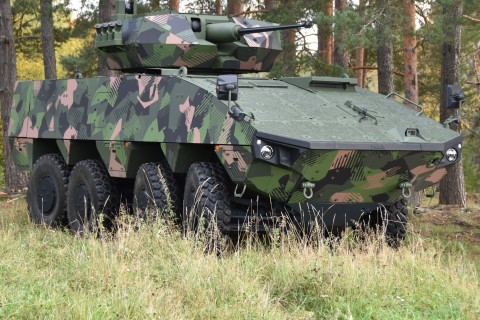
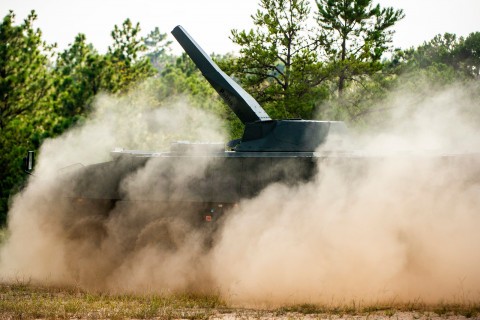
She recently returned to Patria’s Defence and Weapon Systems business area, which is responsible for weapon systems, where preparations are underway for increasing international demand for the Patria NEMO and Patria TREMOS mortar systems.
To support this, production capacity is being systematically expanded, with product quality assurance playing a central role.
We embed quality from the outset through robust methods, clear instructions, effective induction and consistent execution.
Getting the basics right during the scaling phase
As Senior Quality Manager, Satu leads a five-person inspection team responsible for quality assurance at different stages of production.
– Our team also supports production when issues arise on the production line. The aim is to respond quickly and as close to production as possible.
According to Satu, what makes the work particularly interesting is that production is currently in a scaling phase. This is exactly the right time to get the basics in place: clarify instructions, standardise ways of working and build a quality framework that will hold as production grows.
– It is not just about final inspections, but about ensuring that production methods, work instructions, induction and working practices all support the right level of quality from the very beginning.
Thorough induction is essential
Hietala stresses the importance of employee induction in quality assurance. In her view, a general induction for new staff is not enough; each employee also needs more in-depth training specifically related to their own tasks.
– A step-by-step induction process helps ensure that competence develops in a controlled way and that the quality of work remains consistent, even when more new employees join production.
At Patria, integration work is also carried out, where mortar systems are installed, for example, on vehicle platforms. In this kind of environment, quality is particularly important, as the systems consist of many parts that must function seamlessly together.
Satu is involved in planning investments and improvements related to increasing production capacity together with the production team. For her, the most rewarding aspect is the opportunity to influence quality-related matters and help people succeed in their work.
– There is a strong pace of development in the work. In a short time, we have already achieved a great deal as we build the foundation for future growth.
Satu’s own background supports her understanding of the bigger picture. She holds a degree in business administration but has also studied mechanical engineering alongside her work.
– My long experience in a machine shop environment gives me a broad perspective on how quality is developed in practice. My background in business administration also helps me understand the financial constraints of production.
What I appreciate at Patria are the clear ground rules and transparency. Things are done in accordance with the rules, and for example access to training is straightforward.
At Patria, there are opportunities to develop your expertise
Satu values Patria as an employer that offers opportunities to grow and move into different roles, and her own career path is a good example of this.
– What I appreciate at Patria are the clear ground rules and transparency. Things are done in accordance with the rules, and for example access to training is straightforward.
Cooperation with managers also works well.
Satu also appreciates the flexibility that allows work and personal life to be balanced from both sides. Extra effort is made when needed, but there is no expectation to be constantly working during personal time. Overtime is also monitored.
Satu speaks warmly about her colleagues. She says she has met many pleasant people across the organisation and describes the working atmosphere as relaxed.
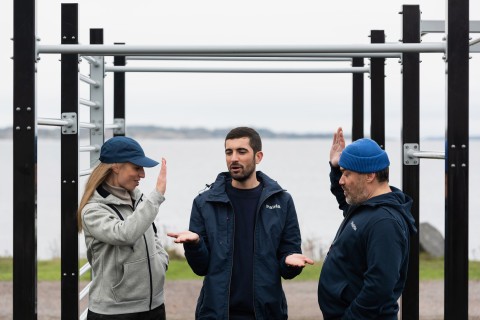
In her free time, Satu enjoys walking and bodyweight training, which became part of her routine after the pandemic. She also expresses her creativity by making silver jewellery.
– My speciality is confirmation crosses. I must have made around twenty of them for my relatives by now.
Text: Matti Remes